

.png)
SPOTLIGHT: Sizwesandile Mnisi and Carl Beukes on the strength of stillness in THE KILLING OF A UNION LEADER
Updated: May 15
Maria Kearns
A king under siege, a city on the edge, a coterie of scheming, self-interested, cynical courtiers: in THE KILLING OF A UNION LEADER, playwright and director Louis Viljoen has produced a political thriller of Elizabethan proportions.
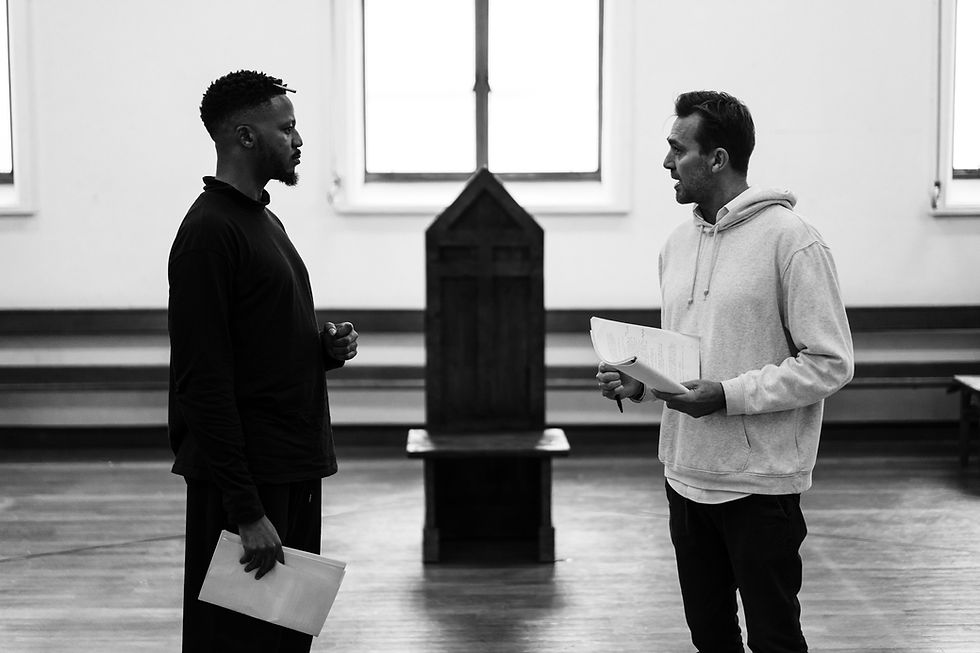
The setting may have evolved from the last stand on some long-forgotten English civil war battlefield to the backroom convulsions of late-stage Capitalism in a South African city, but the powerful will still do everything conceivable to dominate and subdue the expendable peasantry, and the relevance and import of this story haven’t diminished a bit over the centuries.
During the final rehearsal week, I had an opportunity to get a sneak peak at this much-anticipated play. As the actors took a break, I grabbed a moment outside the rehearsal venue in the shade to speak to Sizwesandile Mnisi, who plays Gibson, a union representative, and Carl Beukes, who plays Dobbs, a political operative about the play and their roles.
When I ask the actors what drew them to this play, their answers echo those often heard from Viljoen’s actors: the playwright’s the main attraction.
Carl makes working with his old friend sound like a long-held dream come true:
“Well, I’ve been a fan of Louis’ for years and years and years, and an old friend as well, so I’ve always wanted to work with him, and even while I was living in L.A. for eight years, I used to call him often saying, ‘Just send me another play, send me another play so I can read it’. I just wanted to read his stuff, not thinking I’d ever work with him because I was living somewhere else. But then he said to me, ‘Dude, if you’re ever here, we’ll do something’, and then that just put something in my head, like, sure. The moment I saw myself coming back, I contacted him and said, ‘‘Kay, let’s get it into your head, I’m coming back, let’s do something’. And so, then he called me up and said, ‘Cool, I’ve got a play’, and would I like to read it? I read it and I was like, oh my goodness, this must be the hardest play to do, because it’s so political and wordy, you know… It’s a passionate play.”

I note that this political thriller might not be the easiest Viljoen to dive into as a first-timer.
“No, absolutely,” Carl agrees. “But at the same time, it’s Louis through-and-through, you know… The character work is intense but all in the words—in the dialogue. I mean, it’s a thriller, so it builds like a thriller, but at the same time it has Louis’s original lens on it, you know. Just really incredible.”
“Oh, well, I was gonna say exactly that, so you can just copy and paste,” Sizwe laughs.
“I’ve also always wanted to work with Louis. I love Louis’ work. I remember I watched Champ—(remember Champ? he prompts, as I nod enthusiastically)—when I was still in drama school and I’ll never forget that play. Ever since then I’ve tried to watch Louis’ work. So, when Louis gave me the script, my first reaction was utter horror: ‘How am I gonna do this?’ I hadn’t said yes yet, but I thought, you know, this will be a great challenge. Let’s go, let’s show them you’re an actor, Sizwe.”
“Then I read the script and I loved Louis’ writing in that. Louis writes in a very fragmented way where there’s a lot of repetition that creates a bit of frantic speech but also gives a little bit of reality and poetic writing at the same time. Carl and I were talking about how Louis’ work is so text based that you really just only have the words to show the characters’ emotions and that also translates into Louis’ directing. He doesn’t want you to show a lot of body movements; it’s all in the words. And the story and the world of the play drew me in as well, to see the political conversation that you get in the play: Who has power over who and if power can be shared. I was like, you know what, let’s go. Sign me up.”
Wordiness is a Viljoen trademark, but in this play, there’s practically nothing on stage either. Carl calls it ‘very minimalist’. I ask him and Sizwe whether that bareness creates additional challenges.
“Yeah,” Carl confirms, “it’s tough, because actors are taught… not necessarily taught, but I guess we’re used to furniture, props, things on stage to use to communicate to other characters.”
“Business,” Sizwe supplies before Carl continues.
“So, you communicate with a prop, you communicate with the movement, you communicate with, like, sitting down even, and not having those ways of communication… Like Sizwe said, we can’t even really move, we can’t use our bodies to communicate. Everything emphasises the text. Which is great for the audience, because you’re drawn in through what’s being said, but for an actor, it’s incredibly difficult to brush all those things away and not have anything… you’re basically standing there absolutely naked, really, and just have to sell your character and the story through the words. And Louis’ words are heightened English.”
Sizwe agrees: “Not easy words.”
“It takes a lot of work and a lot of control,” Carl muses, “because, you know, when you’ve got chairs, you’ve got props and stuff, you can kind of let loose a little bit because you’ve got these things to hide behind. You’ve got nothing to hide behind here.”

I suggest that this text probably also requires a deep understanding of what it is you’re saying.
Carl agrees. “Absolutely. You have to dig, dig, dig, dig, dig. Because you can feel it; when you’re on stage and you’re saying these lines, once you understand what he’s saying, you can sense when you can and must go even deeper. There’s a lot more depth to what you’re saying, and when you’re not getting it, it becomes very. It also becomes very apparent onstage if you don’t understand what you are saying, so you think to yourself ‘okay, wait, I’ve really got to dig deeper into this… into this line because it’s there, but it’s not entirely there yet’.”
At this point, I remember something Sizwe mentioned earlier and decide to probe a bit more. I ask whether the experience of rehearsing THE KILLING OF A UNION LEADER has made the actors look at this city and this country in a different way.
“Yeah, of course,” Sizwe says. Then he reconsiders: “Maybe not in a different way, it’s just… that’s how it’s always been. It’s very interesting how Louis speaks on issues but he’s not specific about what he’s talking about, you know. Though the play’s not set in a specific country, in a specific city, you can easily translate it to a South African context. So, I think that’s very powerful. And for people who are inclined to political conversations this is an opportunity to watch such in a different style, as a thriller… But to answer your question, really, let’s have more stuff like this to continue the conversation, to be a catalyst for more conversations.”
He turns to Carl and continues: “It’s one of your lines about the battle between the people who make and the people who worry about what is being made.”
Speaking of their characters, I ask them what they can tell me about the traits and contradictions they’ve been exploring.
“My character is a union representative,” Sizwe starts. “He is all about the people. I don’t know if I can say this, but you know he’s not the leader. He’s all about people working and our country has a history of protest action and strikes. As much as that’s a good way to speak truth to power, there’s always gonna be police retaliation and my character knows that, but at the end of the day I think he’s focused on the purpose of protest action, and in the play he’s trying to find a way to avoid…” Sizwe seems to be considering how much to share. “At the at the beginning of the play, there’s been a massacre, and he’s trying to avoid anoher.”
“I connect with my character because I guess I also got love for the people,” he says somewhat sheepishly. “I guess I just put myself in his shoes. The words are there to help you, so I just focus on his situation and put myself in that situation.”
I suggest that Sizwe’s character seems like an honourable man forced to make a terrible choice.

Carl agrees that Sizwe’s character has been manipulated into a position he doesn’t want to be in. It occurs to me that Carl’s character is the one doing a large share of that manipulation.
“Yes,” Carl agrees, “I’m just playing myself, really.”
“I knew it!” Sizwe exclaims under general laughter.
“I’m a political operator,” Carl continues, and says the emphasis there falls on the word ‘operator’. “I think he’s very good at shifting attention, shifting the blame, and shifting the power to where he needs the power to be. He doesn’t always hold power; in fact, he never holds the power. He likes to give it to certain people to achieve his own goals.”
A different kind of power, I muse, feeling very intelligent.
“It’s actually the best kind of power,” Carl agrees, cementing my burgeoning regard for my own grasp of the subject. “But so as not to get blamed, once something happens, he can always step aside and have no hand in it. Which takes a certain type of person. He’s always asking everybody what’s in it for him; what do I get?” Carl takes a breath as he considers the implications of what he’s saying. “In a way, he’s the most honest person on stage, really; he’s very honest. He’ll never lie, but he’ll always bend the truth.” Another brief pause. “Do I relate to him?” Carl asks rather coyly, eliciting giggles from me and Sizwe. “No!” he answers his own question. “Unless we all do it in a certain way.”
“The fact that you had to think about it…” Sizwe chuckles.
“No, obviously,” Carl sets our minds at ease. “What it taught me about politics is that, you know, we can all say I’m for this party or I’m for that party, but at the end of the day, behind the scenes, they’re all doing what Dobbs does. They’re trying to achieve their goals. They’re cool with these people for now, but only as long as it gives them what they need, and if they walk away, they want to walk away with as little blame as possible. And they’re all doing the same thing. Dobbs is kind of a representation of all of them, in a way.”

As we’re talking about how the show gives the audience a look at how the sausage gets made, I ask the duo whether being in this play feels a bit like being in their own version of Game of Thrones or Succession.
They don’t seem as drawn in by this question as I’d hoped, and I feel my stratospheric rise as theatre interviewer begin to falter.
“Yeah,” Carl shrugs. “I guess more Succession than Game of Thrones. A lot of action in Game of Thrones; there’s no action here.” They both laugh. I feel the need to point out that they do have a massive throne on stage with them throughout, which elicits another round of laughter.
“You know,” Sizwe says, “Louis said to us that he was trying to bring out the cool in us in our first scene. I guess we were not giving cool, and he was, like, ‘If you think of yourself as a movie star, you will look like a movie star’. It’s about switching your thinking and working on thinking that ‘I’m the fucking star’, then it will translate to the audience.” He turns to Carl. “Dobbs, you’re not cool. I’m way cooler than you.” He smiles and turns back. ‘That’s what I feel. I feel like I’m in a cool fucking play where I say cool things and I don’t have to move an inch for you to think I’m cool. I can just stand there and speak.”
Carl nods in agreement, clearly not offended by being the less cool of the two.
“It’s so cool,” Sizwe enthuses. “There’s so much power in the stillness of this play that I’m only actually finding this week [during the final week of rehearsals]. I remember, even yesterday, I made sure I was consciously keeping my hands less busy to see where that would take me and give me a sense of strength, you know.”
“Stillness is strength,” Carl agrees.
“A bit more of that, Dobbs,” Sizwe quips.
“Wow,” Carl drawls. I suddenly find myself wondering what to do if thespian relations suddenly sour halfway through a rehearsal day.
“No, a bit more for me, actually,” Sizwe corrects himself, sparing me any further deliberations regarding becoming an impromptu mediator. “Because I go back to that,” he says, indicating exaggerated hand movements, “because, you know, that’s what I’m used to.”
You’re being forced out of that, I comment.
“Yeah, and it’s a beautiful challenge,” Sizwe smiles.
We lose our collective thread having to move the interview into the bright Cape Town sunshine as we talk outside the rehearsal venue. Having been dazzled by the light, I jump back into the interview somewhat awkwardly by asking Carl how it feels performing soliloquies in a play written in 2026.
Perhaps it’s his long stint in L.A., but Carl is clearly far less fazed by the sun than I am and he gets straight to it. “Yeah, it’s hard, you know. I mean, because this is heightened English, I guess it kind of gives leeway to it in a way.” He thinks for a brief second. “Because you feel like you’re doing Shakespeare again. But you’re not. And also, it is 2026, so it’s hard. Because the audience is going, ‘The fuck is he talking to?’, so you’ve got to keep them there with you, on each and every thought, which is very tough.”
It’s working, I chime in sincerely.
“Thanks,” he says, not appearing to believe me, “but it is weird. Every time I start, I’m like, ‘Okay gotta go into this thing now’. But it’s hard. It’s hard. But, the heightened English helps a lot too; it feels a bit more natural and it takes you out of the real world in your own head.”
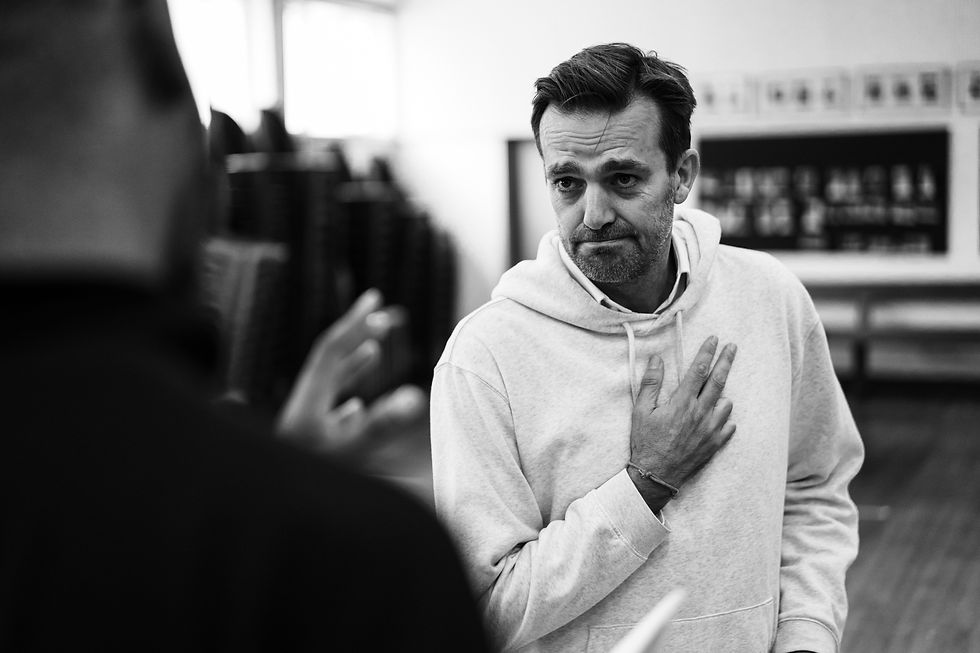
I move on to Sizwe and ask him about his character’s function as foil to some of the courtly shenanigans going on between the other characters.
“I’m the sane one,” Sizwe smiles. “I don’t want to talk too much about race, but I am the only black guy in the cast and the only black character in the show. So there’s already that thing that says, ‘he’s an outsider’. First of all, you read the title and think he’s the union leader who’s going to be killed. But, really, it just fuels my character and my objectives. Okay, I’ve come into the throne room of this man I completely hate, thanks to Mister Dobbs here, but now he’s clearly not with me anymore; he’s with them. So it just fuels and supports what I do.”
It sort of crystallises your whole reason for being where and who you are, I suggest.
“Alone,” Carl adds.
“Alone!” echoes Sizwe. “But with so many people I’m representing, so I come carrying that, and that’s why I will continue, because I know there are so many people dependent on me.”
With that, Sizwe wisely moves our little group back into the shade.
“It’s just been a fun process working with these superstars, you know?” he adds. “It’s been very scary. We’ve had almost no time; we’ve only had three weeks with new work, and it’s been very scary, but Louis has been a really good director. He creates an ease in the room.”
Carl voices his agreement at this.
“He’s very specific about how he wants the work to be done,” Sizwe continues, “but you’re also given room to play. And we work so well together. There hasn’t been any drama. Except…”
“Except us two,” Carl nods.
“We hate each other,” Sizwe laughs. “But it’s been lovely.”
“It’s been really easy as we’ve eased into each other,” Carl confirms. “Just those words, man,” he says, shaking his head.
THE KILLING OF A UNION LEADER will be onstage at Artscape’s Arena Theatre from 12 to 30 May 2026.
The play carries an age restriction of 18 for strong language, descriptions of violence, and scenes of a sexual nature.
Tickets are available through Webtickets and range from R170 to R200 per person.
Production: THE KILLING OF A UNION LEADER
Written and Directed by Louis Viljoen
Performed by John Maytham, Emma Kotze, Sizwesandile Mnisi and Carl Beukes
Designed by Kieran McGregor
Website: www.unionleaderplay.co.za
Dates: 12 – 30 May 2026
Venue: Arena Theatre, Artscape
Bookings: Webtickets
Tickets: R170 – R200
Age Restriction: No Under 18