

.png)
SCENE IT: All should rise to see the people-centred story inspired by June 16th
Updated: May 26
Barbara Loots
Set in the fictional Molefe Secondary School in Soweto, RISE ’76: THE STORY OF JUNE 16TH, onstage at the Baxter Theatre until 30 May 2026, traces a community on the brink, as students, teachers and families confront the devastating implications of Afrikaans being imposed as a medium of instruction. What begins as an ordinary school day unfolds into a moment that will irrevocably shape the course of history.

RISE ’76: THE STORY OF JUNE 16TH is a deeply moving production. At its core, RISE ’76 is the story of two friends and how shared dreams, ideals, connections (friends and family), and struggles (for them, as well as the broader community) shape the people they become… if they are even allowed to become at all. It shows that the unfairness and obstacles they face shape how they engage with the world. From that human-interest perspective, it is a deeply moving story that plays out on the stage at the Baxter Theatre.
Tiisetso Mashifane wa Noni, as both the writer and director of this piece, allows for small moments (albeit within a larger historical context) to speak loudest: A friend impatiently waiting for another to go to school, a mother engaging with her son early morning before she leaves for work, a teacher worrying about her ability to teach in a language she does not understand, a young brother just wanting to be part of whatever is happening with a keen eagerness… all small, human moments which ultimately put them in harm’s way. As the headmaster says to the two friends, “We need to have an honest conversation”. And that hits the nail on the head, RISE ’76: THE STORY OF JUNE 16TH feels like an honest conversation about the dignity, freedom and dreams of people.

Mashifane wa Noni makes it clear that this is a story inspired by the historic events of 16 June 1976, “when South Africa killed its children”, but she did not set out to write an historically accurate play. In that lies its power to transcend to the level of engaging theatre, avoiding the trap of mere “importance”: Importance does not make a production a good, or even a necessary, theatre experience. Importance can be a motivating factor for a creative when writing a new play) but importance should not hang over an audience’s head as the must-see motivation. Engaging and well-presented theatre that makes you feel something (be that sadness, anger, happiness or something in between) is what makes something a must-see.
And RISE ’76: THE STORY OF JUNE 16TH is a success in getting that spot on in terms of being a well-written and executed multilingual and evocative play. The strong ensemble (Zilungile Mbombo, Mfuneli Ntumbuka, Sibuyiselo Dywili, Ben Albertyne, Alex Sono and Botlhale Mahlangu) navigates the emotional undercurrents beautifully, shifting between tenderness, terror, urgency and, ultimately, reflection.
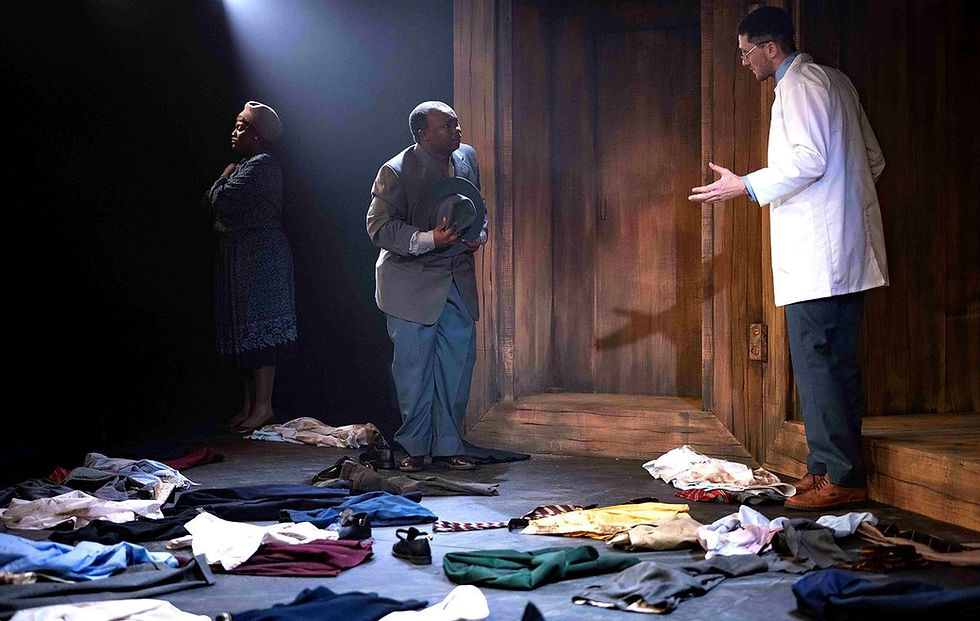
So often plays inspired by historical events would stop at the moment of “impact”, in this instance the 1976 Soweto uprising. But Mashifane wa Noni insightfully takes the audience beyond the impact point and focusses on the aftermath. That considered shift in perspective gives the production an authenticity that looks beyond the conflict, and into the hearts of the characters she imagines having lived through it all while losing so much and so many in the process. Unpacking the heartbeat of people in the aftermath of any violent event is no easy task, and the reward for getting it right is good theatre. In transcending the obvious Mashifane wa Noni gets the subtle and considered opportunity to present the audience with questions surrounding survivors’ guilt and post-traumatic stress, all of which could impact how people choose to (or even choose when to) remember history.
In its theatrical approach, RISE ‘76 honours the memory of the dreams and futures lost during the 1976 student uprisings, as we are reminded by the reoccurring phrase “it all started with a bullet”, and addresses themes of resistance, courage, grief but also hope, particularly the hope that such sadness will not, should not, be repeated. Because the people at the centre of the sadness always deserve better… deserve a future.
RISE ’76: THE STORY OF JUNE 16TH is onstage at the Baxter Theatre Studio until 30 May 2026, before transferring to the Market Theatre’s Mannie Manim from 5 to 28 June 2026. Tickets can be booked online through Webtickets.