


SCENE IT: MOTHER LOAD lifts the veil on the dark side of motherhood
Marina Griebenow
It has been almost a decade since Lara Toselli (née Lipschitz) last appeared on a Cape Town stage as Daphna Feygenbaum, the fiercely devout, uncompromising and vitriolic cousin in Bad Jews, which had runs in 2015 and 2016 at The Fugard Theatre.
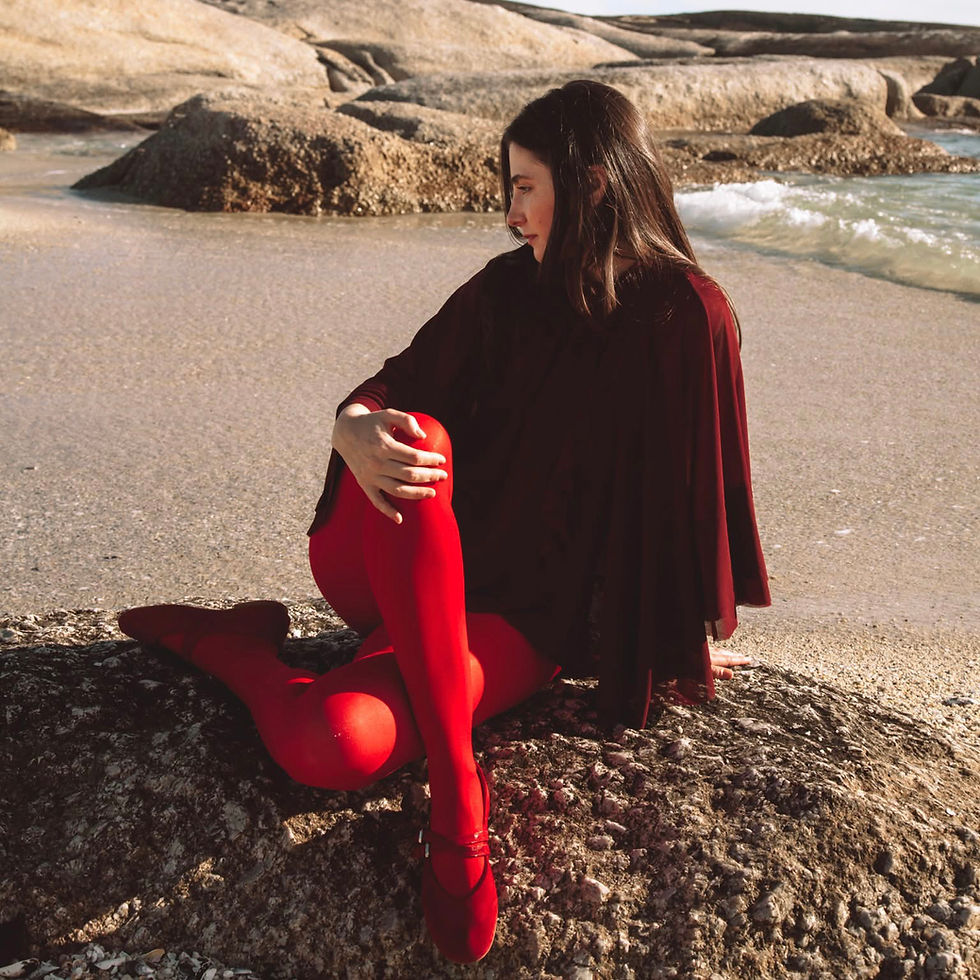
“Lipschitz’s fierce and feisty Daphna never flags her pace,” wrote Karen Rutter in Weekend Special. David Fick, writing for BroadwayWorld, summarised her acting feat excellently: “A great deal of the play's success rests on the shoulders of the actress playing Daphna, and Lara Lipschitz is equal to the challenge. She finds the playing style of the piece effortlessly and manages to allow the audience to feel some empathy for a character that is essentially constructed to be as unlikable a human as possible, not because of her firm faith in her beliefs but because of her inability to acknowledge the humanity of those who disagree with her.” Cape(town)Etc agreed wholeheartedly: “The four stars of Bad Jews are all exceptional performers, but it’s Lara Lipschitz and Glen Biderman-Pam who stand out. Loud, assertive, funny and sensitive, they create both chaos and emotion as two people on opposite ends of the same spectrum.”
Given these accolades, why has it been so long since we saw Toselli on our stages? Some of the details emerge in the course of her slice-of-life offering, MOTHER LOAD, currently on at that nifty new little theatre at the top of Kloof Street –The Antique. Among other things, she got married, they relocated from Johannesburg to Cape Town and back again, and then finally settled in Cape Town for a second time. She became a mother and... ah, there’s the rub!
The reason for this clever piece of writing, which is so much more than merely the sum of its parts, lies in the fact that motherhood for Toselli did not initially live up to expectations. Of course, not many people, not even women, really know much about post-partum depression and the more severe post-partum psychosis.
It just so happens that it was also exactly a decade ago that I first became aware of these conditions through a disturbing play called The Yellow Wallpaper, which I saw at the KalkBay Theatre. Based on a short story by Victorian writer Charlotte Perkins Gilman, the play drew on what was, in essence, a biographical experience and reflected the medical and patriarchal structures of the 19th century that denied women agency over their own lives and bodies. In our day and age, some of the agency gained is taken away by the unrealistic and thoughtless expectations often harboured by well-meaning people and even by young mothers themselves.

On a stage draped entirely in pink cloth to resemble a giant womb, within which the actor and her audience are ensconced together, Toselli proceeds to relate and re-enact, through elements of physical theatre and heightened realism, the turbulent story of her pregnancy, the birth of her daughter, Layla, and the ensuing 18 months during which she felt as if she were underwater, drowning in post-partum depression.
Most alarming in all of this was her sense that she had completely lost sight of who she was and no longer recognised the person she had become. Her “old self” now appeared only intermittently, during periods of high stress, as if to remind her of what life had been like. Director Tinarievan Wyk Loots has strategically placed a crouched figure beneath the cloth at one end of the stage, towards which Toselli repeatedly points or looks when talking about who she used to be. To add insult to injury, her husband’s frequent absences for work during this period felt like abandonment. The world around her appeared beige and without definition, while everything related to her baby felt overwhelming and underwhelming at the same time.
Toselli’s description of her daughter’s birth is visceral, clever and funny, all intensified by an accompanying metaphor: Cape Town was burning everywhere, an all-consuming fire that threatened their property, with flames that seemingly had a will of their own. Her period in labour resembled that runaway fire, but the intensity was relieved every now and then by the well-meaning yet amusing interventions of Fiona, the midwife, and Phyllis, the doula. Toselli has a knack for finding your funny bone when impersonating the other characters in her life. My personal favourite was her mother-in-law, Mascha, who was also instrumental in helping her regain her life force when the darkness finally began to lift.
Kieran McGregor is a gifted lighting designer who has often had to pay his dues in small venues such as the MasambeTheatre at the Baxter Theatre Complex, so The Antique is not unfamiliar territory. What he achieves superbly is to subtly enhance the ebb and flow of Toselli’s moods and emotions as the story progresses. Most marked is the transition when she discovers that she is not the only woman to have experienced post-partum depression and anxiety, followed by her growing frustration with the expectations foisted on new mothers. As an audience member, you feel something gradually lifting, and it is only a while later that you realise that the effect of the lighting has been echoing the text.
It is not surprising that the audience consisted mostly of women, but what was unexpected and heartwarming was the extent to which audience members remained in the space after the play had ended and Toselli had received her applause and standing ovation. Throughout the performance, there had been moments when audience members had voiced their recognition of what was unfolding on stage. Now those same women sat and talked in a manner that made it clear that the play had hit a nerve or two, or even three. It was extremely gratifying to see theatre doing what it does best – getting people talking about the things they had recognised in a production as pertaining to their own lives, and about the impact these had had on them.
There is no reason why this complicity of silence surrounding post-partum depression and anxiety should continue. Plays like MOTHER LOAD, ably performed by Toselli and skilfully guided by Van Wyk Loots, serve to lift the veil somewhat. It is, after all, the 21st, not the 19th century.
If the audience reaction is anything to go by, Toselli can take credit for a job well done, not only as a writer and actress, but as a woman and mother. After 18 months of suffering, her mother load had eventually turned into the mother lode: that abundance of something desirable.
MOTHER LOAD, written and performed by Lara Toselli
Director: Tinarie van Wyk Loots
Set and costume design: Rocco Pool
Lighting design: Kieran McGregor
At The Antique Theatre until 31 October 2026